|
ABSTRACT SUBMISSION GUIDELINES
Authors should format their documents using the styles provided bellow. Please follow the instructions carefully. Any abstract with errors or omissions will be returned to the sender for correction.
- The text should be in clear and concise English. Please be consistent in punctuation, abbreviations and spelling.
- Font should be Times New Roman, size 12 pt, Text should be single-spaced. Please leave blank lines between the title and the body of the abstract.
- Avoid citing references in the abstract.
- Use bold capital letters for typing the title of the abstract. Then type author`s name(s), (in bold) address, fax and E-mail. Underline the presenting author`s name only. A maximum of 6 key words, related to your abstract but not in your title, should be given at the bottom of the abstract.
- Use of standard abbreviations is desirable. Place special or unusual abbreviations in parentheses after the full term the first time it appears.
- The SI system should be used for all measurement units. Use
 M or mg l-1 instead of mg/l. M or mg l-1 instead of mg/l.
- Binomial Latin names should be used in accordance with the International Rules of Nomenclature. In the title after the Latin name of the species the name of its author should be included. Latin names should be typed in italics in the abstract.
- The body of the abstract is limited to one paragraph of 250 words. Begin with a clear statement of the problem or objectives, give brief methods and major results, and end with a substantial conclusion. Abstracts that exceed 250 words will be returned to the author for revision. (see the abstract example)
- All submissions should be sent in MS Word doc-format only to the following E-mail address: iviliev@ltu.bg or ivilievltu@yahoo.com not latter than April 15, 2007
- Abstracts submitted to the conference will be evaluated and selected for poster or oral presentations. The authors of the chosen abstracts will be asked to prepare and bring posters with them. At this session presenters are asked to stand by their poster/exhibition in order to discuss their research/design project with viewers.
- If your abstract is accepted but cannot be accommodated as an oral presentation, you will be notified as soon as possible so that you will have ample time to prepare a poster
- The acceptance note will be sent to authors well before the registration deadline for early registration (until May 15, 2007).
Deadline for abstract submission: April 15, 2007
Abstract Example
FORCING SOFTWOOD SHOOTS, ROOTING, AND MICROPROPAGATING HYDRANGEA QUERCIFOLIA BARTR.
Wei Tang¹ and John E. Preece²
¹East Carolina University, Department of Biology, Howell Science Complex, Greenville, NC 27858, USA
Tel. 252 328 2021, Fax: 252 328 4178, E-mail: tangw@mail.ecu.edu
²Department of Plant, Soil and General Agriculture, Southern Illinois University, Carbondale, IL 62901-4415, USA
Tel: 618-453-1796; Fax: 618-453-7457, E-mail: jpreece@siu.edu
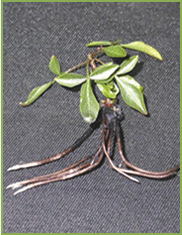
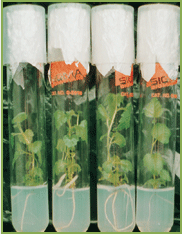
Woody stems and roots were removed from Hydrangea quercifolia, cut into 40 cm segments and placed horizontally in flats of perlite to produce leafy softwood shoots under intermittent mist for cutting propagation studies or under drip irrigation for micropropagation studies. When stem and root segments were compared, root segments produced fewer shoots than apical and middle stem segments under both forcing environments. Forcing was better under intermittent mist than with drip irrigation. Softwood shoots from forced stem segments and outdoor shrubs were excised and were treated with 0, 1000, 5000, or 10,000 mg l-1 KIBA and then placed in a 1 vermiculite : 1 perlite (by volume) medium under intermittent mist. Shoots rooted at  80% with or without auxin. Forced softwood shoots from stem segments produced a greater number of roots than softwood shoots from outdoor shrubs; however, there were no differences in percent rooting between the two sources. 'Dayspring' produced the fewest adventitious roots compared to 'Ellen Huff', 'Snow Queen', and an unnamed selection. However, the unnamed selection had the lowest rooting percentage. Nodal explants collected from the forced shoots and greenhouse-grown plants were disinfested and placed in vitro on MS medium containing 1 M indole-3-butyric acid (IBA) and 10-10, 10-9, 10-8, 10-7, or 10-6 M thidiazuron (TDZ). Nodal explants on the medium with 80% with or without auxin. Forced softwood shoots from stem segments produced a greater number of roots than softwood shoots from outdoor shrubs; however, there were no differences in percent rooting between the two sources. 'Dayspring' produced the fewest adventitious roots compared to 'Ellen Huff', 'Snow Queen', and an unnamed selection. However, the unnamed selection had the lowest rooting percentage. Nodal explants collected from the forced shoots and greenhouse-grown plants were disinfested and placed in vitro on MS medium containing 1 M indole-3-butyric acid (IBA) and 10-10, 10-9, 10-8, 10-7, or 10-6 M thidiazuron (TDZ). Nodal explants on the medium with  10-8 M produced 0-1 axillary shoots. Shoot numbers were highest on media containing 10-7 M TDZ and most of the shoots were adventitious. Microshoots were easily rooted and acclimatized to the greenhouse. 10-8 M produced 0-1 axillary shoots. Shoot numbers were highest on media containing 10-7 M TDZ and most of the shoots were adventitious. Microshoots were easily rooted and acclimatized to the greenhouse.
Key words: auxin, cuttings, epicormic shoots, indolebutyric acid, oakleaf hydrangea, tissue culture
Poster Presentation Guidelines
Instructions to prepare a poster:
- Paper size: Paper size should not exceed A0 format (841mm x 1189 mm / 33" x 47") in portrait (vertical) set-up.
- Poster Set-up: Each poster presenter will tack his/her poster on a dedicated board. It is your responsibility to set-up your poster. Poster boards and appropriate pins for sticking the poster into the board will be provided during the conference.
- Poster authors must take care of printing the poster and bringing it to the conference for display.
Posters will be displayed during the meeting and the poster sessions will be followed by discussion between authors and attendees.
Presenting authors (oral or poster) must register and pay the registration fee for the meeting prior to June 30, 2007.
|