

















|
Departure from Sofia: September 8, 2007, 7.00 h., from Park-hotel Moskva
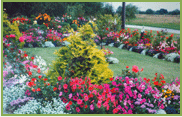
The Bulgarian-Dutch society Bulland Trade Ltd. was founded in 2004 with the main subject of activity – production and trade with ornamental plants. The company opened its nursery on 21 September 2006 near the village Bratanitsa in the western part of the Thracian plain. Partners in the society are the Dutch companies D.v.d. Bosch Export B.V. and Combinatie Mauritz B.V. together with Gardenia – Tatyana Boyadzhieva, Alvers – Stoil Nanovski and KIO – Ivan Uzunov Ltd. from Bulgaria. The total area of the nursery is 10 ha, about 3 of them are used in the moment. The current total number of plants grown in the nursery is 130,000. It is planned to increase it up to 300,000 in 2007. For the time being the company offers 214 species of ornamental shrubs, 101 evergreen plant species and 52 broad-leaved and coniferous tree species. The cultivation of high-quality conifers, shrubs and big-size trees at the nursery is executed according to Dutch technology and cultivating techniques and meets the requirements of EU standards. The shrubs are cultivated in containers with volume of 1.5, 3.5 and 10 litres, while the trees are cultivated in containers with volume of 45, 75 and 100 litres. This allows plants to be planted all around the year, and makes easy the work of landscape architects and everyone else concerned with the beauty of plant life.
"Todoroff" is the first boutique wine cellar in Bulgaria, the inheritor of rich culture, traditions and inspiration, coming back from the centuries. It is specialised in production of high quality red wines of grape varieties Mavrud, Merlot and Cabernet Sauvignon in boutique series of limited quantity. The cellar is situated in Brestovitsa - one of the villages, symbolic for the Bulgarian wine production.
The small town Koprivshtitsa (ca. 2600 inhabitants) is situated in Sredna Gora Mts. at altitude 945-1060 m a.s.l., some 110 km eastbound from Sofia. It is an old settlement, most probably established at the end of the Second Bulgarian Kingdom (14th – 15th century). In the period of the Ottoman Empire (14th – 19th century) the town preserves its Bulgarian pattern. During the 18th century and first decades of 19th century Koprivshtitsa was flourishing town with population ca. 12,000 and centre of many handicrafts. The church "Uspenie Bogorodichno" (The Assumption of Blessed Virgin Mary) is a valuable representative of the architecture of Bulgarian Renaissance period. It was built in 1817, the iconostasis was made in 1821 and the icons – in 1837-1838. The church "Sveti Nikolai" (St. Nicholas) dates back in 1842-1844. The school "St. Cyril and St. Methodius" was built in 1837. The small stone bridge "The First Rifle" is a landmark from the April Uprising in 1876. Most of the houses preserved until today were built in the 19th century. They are remarkable for their architecture, interiors with wood-carving, wall-paintings, etc. Today Koprivshtitsa is ethnographic museum in the open air, national historical and architectural reserve and is a popular tourist destination. Every 5 years the town hosts the biggest and most famous Bulgarian authentic folklore music festival. More than 16,000 participants present the national folklore heritage on 9 stages in the town and outskirts.
5 and 6 September, 2007 Price: 70 Euro per person
The organisers have contacted a tourist agency which offers two-day sightseeing tour for accompanying persons as follows:
- St. Alexander Nevski cathedral with the crypt
During the sightseeing tour accompanying persons will also visit the National Art Gallery and the National Archaeological Museum. Important notes: This excursion will be possible only if at least 10 people from the accompanying persons sign up for it.
The price of the excursion includes transportation, insurance, tourist guidance in English, guided tours in the museums,
and entrance tickets to museums.
Please inform us not later than 10 August For any additional questions you might have, please contact the conference organisers - Dr. Alexander Delkov |


Home |
News & Important Dates |
Location |
Scientific Program
Registration |
Arrival |
Accomodation |
Abstracts
Social Program |
Poster |
Contacts
© www.journal-pop.org. All right reserved.
